
How Many Drippers
Per Plant?
The Two-Stakes Rule
It is the question we get more than any other about drip irrigation, and it is almost always asked the wrong way round. People ask how many drippers a plant needs. What they should be asking is how many stakes go in the pot — because a dripper assembly and a dripper stake are not the same thing, and mixing the two up is how growers end up ordering half the kit they need.
Here is the short answer, and then the reasoning behind it.
Two Stakes a Pot
One stake wets a cone straight down one side of the root ball and leaves the rest dry. Two, pushed in on opposite sides, wet it through.
This is not a rule of thumb we made up. It falls out of how water actually moves through a medium. A single emitter does not spread sideways nearly as much as growers expect — in coco it drops almost vertically, and in rockwool it fans a little wider but still nothing like pot-width. Whatever it misses stays dry, salts up over the run, and the roots in that half of the pot never do the job you are paying for.
Two stakes on opposite sides halves the distance water has to travel to reach any given root, which is the whole trick. Three or four in a big pot is better again, but two is the point where the return per pound spent stops being obvious.
The Bit That Trips Everyone Up
Now the part that causes the ordering mistakes. An assembly is not a stake. A FloraFlex micro dripper assembly is one lead off the ring, one emitter, and then a splitter that divides it into one, two or four stakes. So how many assemblies you need for two stakes a pot depends entirely on which assembly you buy:


One lead, one emitter, then a splitter. Left to right: one stake, two, four — which is why the number you need to order changes even though the number of stakes in the pot does not.
Read that middle column again, because it is where the money is. Twelve plants on 1-way assemblies is twenty-four assemblies. Twelve plants on 2-way assemblies is twelve. Twelve plants on 4-way assemblies is six. Same two stakes a pot in all three cases — wildly different order.
The Number Nobody Checks
Look at the right-hand column now, and notice it is not a rounding difference. A 1-way build delivers eight times the water per pot that a 4-way build does, because the emitter rating is per assembly and the stakes divide it between them.
Same two stakes in the pot. Eight times the water going into it.
That is not a fault in the range, it is just how a splitter works — but it does mean the assembly you pick is a much bigger irrigation decision than the price difference suggests. A 4-way build on 0.25 GPH a pot wants short, frequent shots and a lot of them; a 1-way build on 2 GPH a pot will flood a small pot if you run the same schedule.
Rough guide: bigger pots and longer irrigation events suit the 1-way and 2-way; small blocks and crop-steered, many-shots-a-day schedules are where the 4-way earns its place. If you are new to drip and not yet steering, the 2-way is the one that will forgive you the most.
Pressure Decides Whether Any of This Works
You can get the stake count perfect and still end up with uneven pots, and when that happens it is nearly always pressure.
FloraFlex emitters are pressure compensating, rated 15–50 PSI and happiest between 25 and 35. Inside that band they hold their rated flow no matter where they sit on the ring, which is exactly why you want them — the far corner gets the same as the pot next to the feed tee. Below the band, though, they do not politely deliver a bit less. The diaphragm stops regulating altogether and evenness falls apart, which is when people start pulling stakes out looking for a blockage that was never there.
Flow is not the problem
A hundred 1-way drippers is around 379 litres an hour. A small submersible moves that in about five per cent of its rated flow, so the pump is barely working. Friction is not the problem either: push that flow down sixty metres of 16mm ring and you lose roughly a quarter of a PSI.
Lift is the problem
Every metre the water has to climb out of the tank costs about 1.4 PSI. That is the number that decides your pump — not how many plants you have. A small tent with the reservoir right beside it will run on an 8m head pump, but only just. Eight metres works out at about 11 PSI, which is under the floor, and it is not enough to open the DNL that comes in a standard whip kit at all, so that build wants the no-DNL kit and a manual flush on the far tee. A bigger room, or a tank down a flight of stairs, needs a 3 bar pump, and that one comes with a 40 PSI regulator for a reason: it pushes about 43, and the emitters should not sit above 40.
If your drippers are behaving oddly and the pressure is right, the other usual suspect is air in the line — we covered that in air locks in drip irrigation.
A Worked Example
Stakes needed: 12 pots x 2 = 24.
On 1-way assemblies: 24 assemblies. That is one pack of 20 plus 4 singles. Each pot receives 2 GPH across its two stakes.
On 2-way assemblies: 12 assemblies, one per pot, 1 GPH split half and half between the stakes.
On 4-way assemblies: 6 assemblies, each feeding a pair of pots, 0.25 GPH a pot.
Ring: roughly 7.2m of 16–17mm LDPE around the canopy, four corner elbows, a feed tee in the middle of one side and a flush tee directly opposite it so water travels both ways round and meets with equal pressure.
Holes: one per assembly, punched with the Flora hole puncher. You will not enjoy doing this without one.


The rest of the loop. The puncher is the one nobody orders and everybody regrets — a screwdriver leaves a ragged hole that weeps for the whole run.


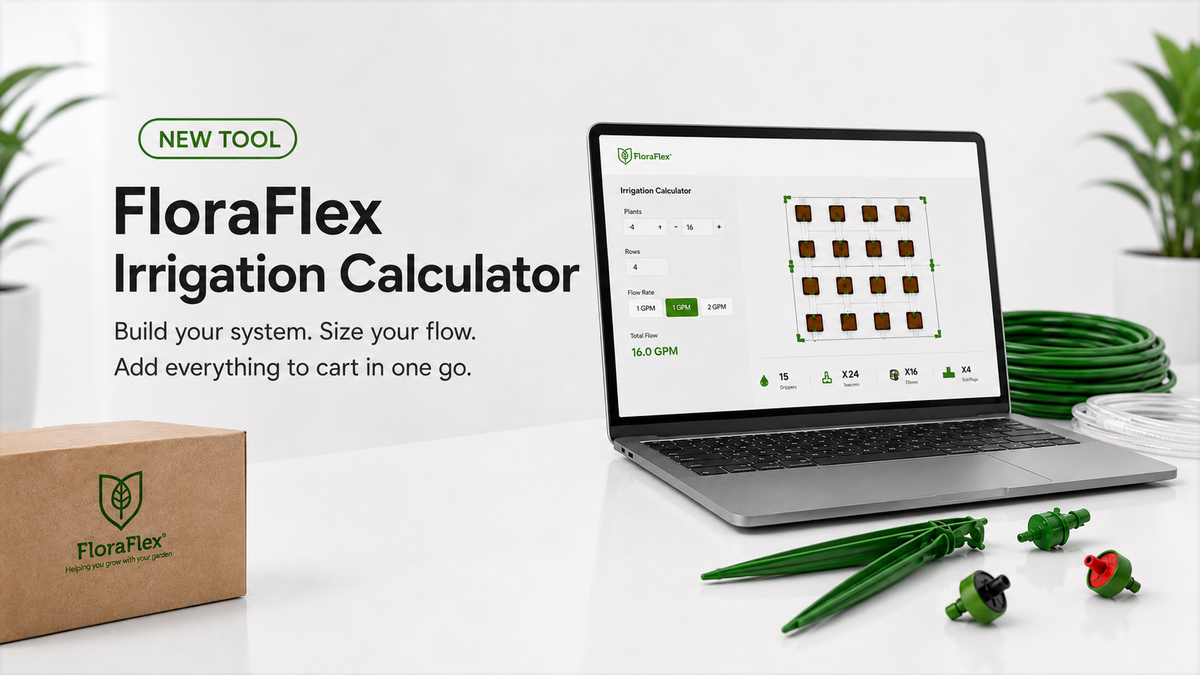
The same build in the calculator. You give it the room and the plant count; it draws the loop, places the feed and flush tees, and counts what that comes to — note the drip points: 24 for 12 plants, which is the two-stakes rule doing its work.
All of which is a lot of counting to do by hand for every change of mind about pot size — so we built something to do it.
Let the Calculator Do the Counting
Our FloraFlex drip system calculator works to exactly the model above. Give it a canopy size and a plant count, pick your assembly, and it works out the stakes, the assemblies, the pipe length, every elbow and tee, the pump that will hold pressure over your particular distance, the media, and the platforms and drainage if you are collecting runoff. Then it puts the lot in your basket in one go, with 10% off the FloraFlex parts at checkout.

An example build, not a live quote — prices move. The 10% comes off at the checkout page rather than in the basket, which is why the calculator states both numbers rather than quietly showing the lower one.
Untick anything you already own and the total follows. It is free, there is nothing to sign up for, and nothing goes in your basket until you press the button.
If your room happens to be a standard size, our pre-built FloraFlex microdrip kits cover 4 to 24 plants in 4x4 and 8x4 spaces and will save you the exercise entirely.
Count stakes, not drippers.


