
The Hydro Bros Growing Advice
Grow Room Extraction Guide: How To Choose The Right Fan & Filter
Extraction is one of those things people tend to size from the tent alone. That's a decent starting point, but it isn't the whole job. The light, carbon filter, ducting, bends and temperature of the room all affect how much air the fan actually needs to move.
If you just want a quick starting point, use the table below. If you want to understand why, keep reading. We'll go through the calculation, the filter, AC versus EC, ducting, setup and the mistakes we see all the time.
If you're building the whole setup from scratch, our grow tent setup guide covers the tent, light and extraction as one system.
Work out the volume of the space first, then allow for the carbon filter, ducting and heat load. A slightly larger speed-controlled fan normally gives you more headroom and lets you run quieter than a smaller fan working flat out.
What Size Extraction Fan Do I Need?
This is the shortcut we use as a starting point. It is not a promise that every tent of the same size needs exactly the same fan.
| Grow space | Typical starting size | What changes it |
|---|---|---|
| 60 x 60 to 80 x 80cm | 4 inch | Higher heat loads or restrictive duct runs |
| 100 x 100cm | 4 or 5 inch | Light wattage and room temperature |
| 120 x 120cm | 5 or 6 inch | 6 inch gives useful headroom |
| 150 x 150cm | 6 inch | Heat load, filter and duct run |
| 240 x 120cm and larger | 6 or 8 inch+ | Multiple lights and longer duct runs matter much more |
The important bit is the m³/h rating, not just whether the fan has a 4, 6 or 8 inch connection. Two 6 inch fans can move very different amounts of air.
How To Calculate The Airflow You Need
Start with the volume of the room or tent:
For a 1.2 x 1.2 x 2m tent:
1.2 x 1.2 x 2 = 2.88m³
If you're using one complete air change per minute as the baseline, multiply the volume by 60:
2.88 x 60 = 172.8m³/h
That 173m³/h figure is the baseline air exchange. It is not automatically the fan you should buy.
Think of it in four steps:
1. Calculate the volume.
2. Decide on the baseline air exchange.
3. Allow for the resistance from the carbon filter, ducting, bends and any silencers.
4. Check whether the lighting and incoming room temperature create a bigger heat-removal requirement.
Fan ratings are normally quoted in free air. Once you put a carbon filter and ducting on the fan, the airflow you actually get drops. That's why buying exactly the bare calculated figure can leave you short. citeturn0search4turn0search6
For a straightforward 1.2m tent, we'd normally rather have a controllable 6 inch system with headroom than a smaller fan that has to run flat out whenever the room gets warm.
Don't Size Extraction From The Tent Alone
A 1.2m tent with a modest LED isn't dealing with the same heat load as the same tent with a hotter, higher-powered lighting setup.
That's why the tent-size table is only the start. If the room feeding the tent is already warm, the duct run is long, the filter is restrictive or you're dealing with a lot of lighting, you need more headroom.
And remember what extraction can and can't do. It can only pull the grow space towards the temperature of the incoming air. If the room supplying the intake air is already too hot, a bigger extractor isn't an air conditioner.
A fan with enough spare capacity to be turned down most of the year and turned up when conditions demand it. Not a fan that is already at 100% on day one.
What Is Actually In An Extraction Kit?
At its simplest, you're buying four things that have already been matched together:
Inline fan. This moves the air.
Carbon filter. This scrubs odour from the extracted air.
Ducting. This gets the extracted air where it needs to go.
Clamps or clips. These keep the joints sealed.
After that, kits vary. Some include a speed controller. Some fans have control built in. Some include the power lead and some don't. Some use a better filter or quieter ducting. That's why two kits with the same diameter can be nowhere near the same price.
AC vs EC Extraction Fans
AC Fans
Usually cheaper to buy and perfectly usable for straightforward setups. Speed control may require a separate compatible controller, depending on the fan.
EC Fans
Generally easier to control smoothly and can be more efficient, especially when running below maximum speed. They cost more upfront, but make a lot of sense in rooms running long hours.
I wouldn't buy EC because somebody told you it automatically uses half the electricity of every AC fan. That's too broad. Compare the actual fan's airflow, power consumption and control options.
For most people buying a new system now, EC is worth looking at if the budget allows. For a small basic tent where upfront cost matters, a decent AC setup can still do the job.
Choosing The Carbon Filter
The filter and fan need to work together. Start by checking the filter's airflow rating against the airflow you're actually asking the fan to move. Don't choose a filter just because the flange happens to be the same diameter.
Matching diameters is still the easiest, cleanest way to build a normal system. A 150mm fan, 150mm filter and 150mm duct run avoids unnecessary reducers and restrictions. But reducers aren't automatically wrong. What matters is the airflow and pressure drop across the complete system. citeturn0search1turn0search11
Bed depth
More carbon generally means more capacity and potentially a longer useful life, but also more weight and cost. Check the manufacturer's recommended and maximum airflow figures rather than assuming every filter with the same diameter performs the same.
How long does a carbon filter last?
There isn't one honest number. Humidity, airflow, contaminant load, run hours and carbon quality all affect it. If odour starts getting through and you've ruled out positive pressure, duct leaks and an airflow mismatch, the filter may simply be spent.
Keep the pre-filter clean and follow the manufacturer's maintenance guidance. I wouldn't automatically tell everybody to turn a filter around halfway through its life unless the manufacturer of that filter recommends it.
Ducting Matters More Than People Think
Fans are much happier with short, straight duct runs. Every metre, bend, reducer and silencer adds resistance. Flexible ducting crushed into a tight bend can make a good fan perform like a much smaller one. citeturn0search1
Combi ducting is cheap and easy for short runs. Acoustic ducting helps reduce air noise. Phonic Trap is the option we'd look at when keeping noise down really matters.
Don't obsess over an exact percentage loss for every 90 degree bend. The real loss depends on the bend radius, duct diameter, air velocity and the rest of the system. The practical advice is simpler: keep it short, keep it smooth and avoid tight turns.
How To Set Up Grow Tent Extraction
For a normal tent, our preferred layout is:
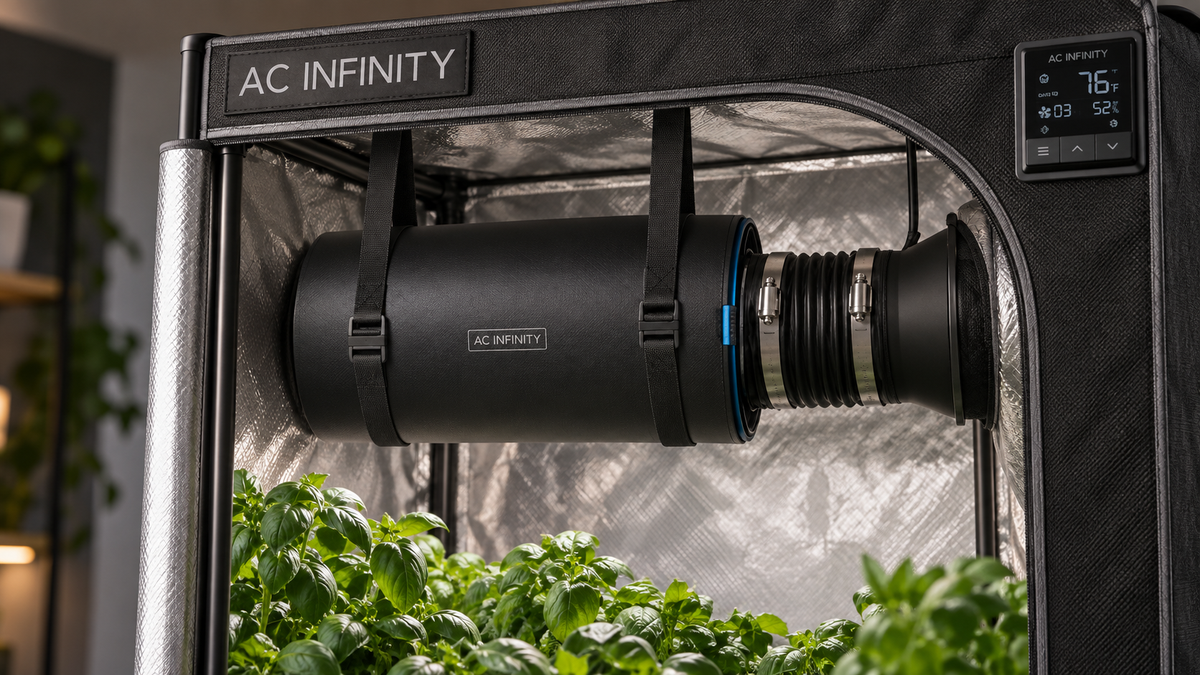
Put the filter high in the tent where the warm air gathers, pull air through it and exhaust that air away from the tent. The extraction should be stronger than the intake so the tent sits under slight negative pressure.
That slight inward pull on the tent walls is useful. It tells you air is being drawn into the space rather than pushed out through gaps and zips.
A carbon filter can also be installed in a push configuration where the equipment and manufacturer allow it. It isn't automatically wrong. Pull-through is simply the layout we'd normally choose because it's straightforward, keeps the filtered side of the system simple and makes negative pressure easy to maintain.
If you're short on passive intake, the grow tent setup guide also covers adding extra lightproof intake ports.
Extraction Kits Compared
We stock everything from basic AC kits to quieter EC and smart-controlled systems. Prices and variants change, so rather than hard-coding a giant price list into an evergreen guide, use the live collection below for today's options.
| Type | Best for | What to look for |
|---|---|---|
| Basic AC kit | Lower upfront cost | Controller compatibility, filter quality, included lead |
| EC kit | Long-running rooms and smoother control | Airflow range, included dimmer/controller |
| Silenced kit | Bedrooms, flats and noise-sensitive rooms | Fan casing, acoustic ducting, mounting |
| Smart-controlled kit | Automatic temperature/humidity response | Controller features and sensor compatibility |
See all grow room extraction kits. If you'd rather build it yourself, browse extractor fans, carbon filters, ducting, silencers and fan controllers.
Common Extraction Mistakes
Buying from diameter alone. A 6 inch connection doesn't tell you how much air the fan moves.
Using the free-air rating as the real-world result. Filters and ducting add resistance.
Under-sizing the carbon filter. Check the airflow rating, not just the flange.
Too much ducting. Keep the run as short and straight as the room allows.
Too much active intake. If intake overpowers extraction, you can lose negative pressure.
Trying to extract your way out of a hot intake room. If the air entering the tent is already too warm, deal with the room as well.
Ignoring noise until everything is installed. A larger controllable fan, soft mounting and quieter ducting are much easier to plan from the start.
Grow Room Extraction FAQs
What size extraction fan do I need for a 1.2 x 1.2m tent?
As a practical starting point, we'd usually look at a 5 or 6 inch system, with 6 inch giving more useful headroom. Check the actual m³/h rating and allow for the filter, ducting, lighting and room temperature rather than buying from diameter alone.
How do I size a carbon filter?
Check the filter's airflow rating against the fan and the airflow you expect to run. Matching flange diameters makes installation easier, but airflow compatibility matters more than the number printed on the spigot.
Do I need an intake fan?
Not always. Many tents work perfectly well with passive intake. If you add active intake, keep extraction stronger so the tent maintains slight negative pressure.
Should I run extraction at night?
Usually, yes. Temperature may fall when the lights go off but humidity can rise quickly. A controllable fan lets you reduce the speed rather than shutting ventilation off completely.
How do I make my extraction quieter?
Use enough fan capacity that it doesn't need to run flat out, keep ducting smooth, use acoustic ducting or a silencer where needed, and isolate vibration rather than hard-mounting the fan to something that can resonate.
Why does my grow tent still smell with a carbon filter?
Check that the tent is under negative pressure, inspect duct joints for leaks, make sure the filter isn't being pushed beyond its airflow rating and consider whether the carbon has reached the end of its useful life.
Can the carbon filter go outside the tent?
Yes, if the layout and filter allow it. Inside the tent on the suction side is usually our first choice because it is simple and keeps the tent under negative pressure, but external and push configurations can work when they're designed properly.
Still Not Sure What Size You Need?
Tell us the tent or room dimensions, what light you're running and roughly where the extracted air has to travel. That's enough for us to point you in the right direction.
Shop Extraction KitsGrow Tent Setup GuideSteve Wong
Co-founder, The Hydro Bros. We size extraction systems for customers every week in the shop and online. If you're stuck between two sizes, send us the room dimensions, lighting and duct route before buying the wrong one twice.


