
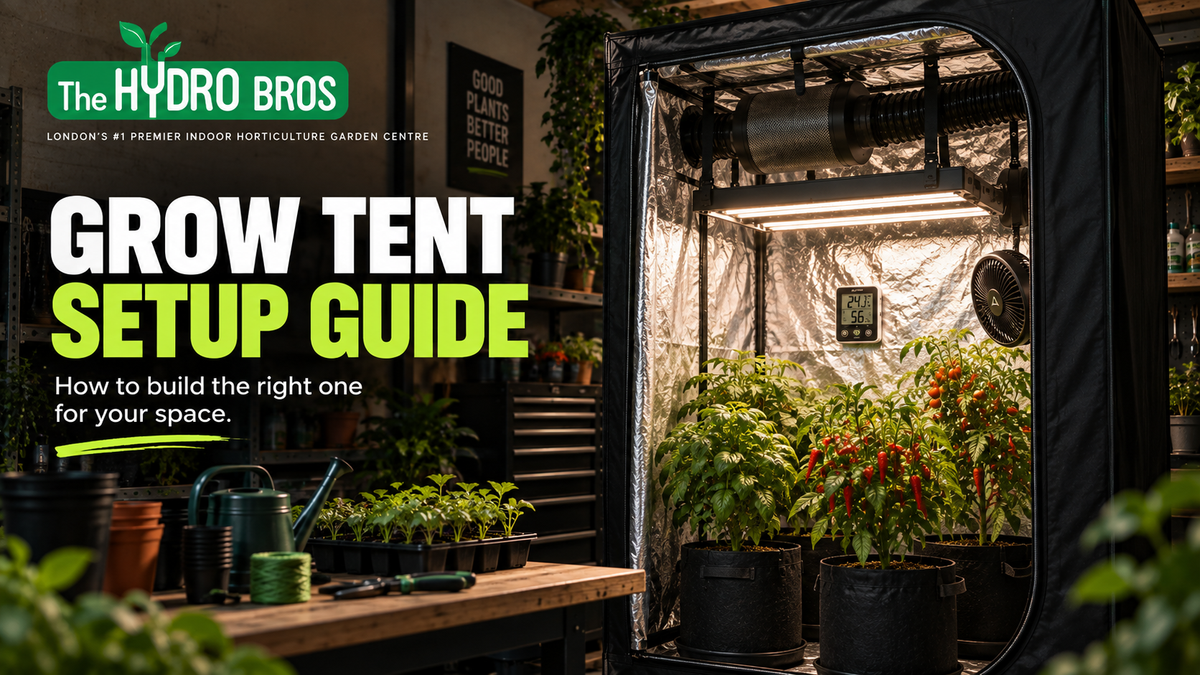
The Hydro Bros Growing Advice
Grow Tent Setup: How To Build The Right One For Your Space
Buying a grow tent is the easy bit. Getting everything inside it to work together is where people usually come unstuck.
We see it all the time in the shop. Someone buys a decent tent, a decent light and a decent extraction fan, but none of it has really been sized as one system. The light is too much for the space, the fan struggles once a filter is attached, or they've bought the biggest tent they can physically squeeze into the room and then can't actually get around it.
So if I was putting a new tent together from scratch, this is how I'd do it.
Put your available space into our Grow Tent Kit Builder and it'll help match the tent, light and extraction to the space.
Start With The Space You've Actually Got
Don't start by choosing a tent. Measure the room first. Width and depth obviously matter, but so does height and the space around the tent. You need to open it, get to the plants, remove runoff and reach the equipment without having to dismantle half the room.
Height catches people out more than you'd think. The pot, plant, light, hanging gear and the gap between the light and canopy all eat into it. If the room gives you the choice between two suitable tents and one is taller, I'd normally take the extra headroom.
| Tent size | Footprint | LED starting point |
|---|---|---|
| 60 × 60cm | 0.36m² | 100 to 150W |
| 75 × 75cm | 0.56m² | 150 to 250W |
| 100 × 100cm | 1.0m² | 250 to 400W |
| 120 × 120cm | 1.44m² | 400 to 600W |
| 150 × 150cm | 2.25m² | 600 to 800W+ |
| 240 × 120cm | 2.88m² | Usually two fixtures |
Those wattages are a rough starting point, not a buying rule. A better light can do more with the same power, and two fixtures with the same wattage can spread that light very differently. Check the actual coverage and PPFD map for the fixture you're looking at.
What Actually Makes A Good Grow Tent?
Two tents can be exactly the same size on paper and feel completely different once you've got a light and filter hanging in them.
The frame
The roof bars are carrying more than people realise. A proper light, filter and fan soon add up. On bigger tents especially, I'd rather have solid metal poles and decent connectors than save a few quid on the frame.
The height
Extra height gives you options later. You can move the light, manage a taller canopy and keep more of the extraction gear out of the way.
Zips, ports and the boring bits
This is the stuff you'll actually notice after six months. Zips that don't snag, sensible ducting ports, cable openings in the right places and a floor tray you can remove and clean. I'd pay more attention to those than a huge reflectivity percentage printed on the box.


Choose The Light For The Footprint
Don't buy a light because the wattage sounds right. You're trying to light a footprint evenly. That's the job.
Look at the manufacturer's recommended coverage, PPFD map, efficacy, total output, dimming range, physical size and warranty. I generally like bar style LEDs for larger square tents because spreading the diodes over a bigger area makes even coverage easier.
| Tent | Current option | From |
|---|---|---|
| 60 to 75cm | Lumatek 100W LED Bar | £169.00 |
| 75 to 100cm | Lumatek ATS PRO 200/300W | £219.00 |
| 100cm | Maxibright Daylight 300W | £189.00 |
| 120 × 120cm | Maxibright Daylight 480W | £264.99 |
| 150 × 150cm | Maxibright Daylight 660W | £274.00 |
Prices above were current when this guide was put together. Check the product page for the live price and stock.
Extraction Is Where Most People Get Caught Out
Start with the volume of the tent. Width × length × height. A 1.2 × 1.2 × 2m tent is 2.88m³.
That's only the starting point. Once you add a carbon filter, ducting and bends, the fan has more resistance to work against. Then you've got the heat from the light, the temperature of the room outside the tent and the humidity you're trying to remove.
This is why I wouldn't choose a fan that only just works on paper. Give yourself some headroom. A decent EC fan running below full speed is usually a nicer thing to live with than a smaller fan screaming away at 100% all day.
| Tent | Good place to start | From |
|---|---|---|
| 60 to 75cm | Garden HighPro Extraction Kit | £70.95 |
| 100cm | Global Air RVK Extraction Kit | £130.00 |
| 120 × 120cm | AC Infinity 6 inch Extraction Kit | £228.99 |
If you want to go deeper on this, have a look through our extraction kits. The important thing is to size the whole system, not just the bare fan.
Fan, Filter And Ducting All Affect Each Other
A good fan with the wrong filter can still be a bad extraction system. Check the airflow rating of both and remember that every bit of ducting you add makes the fan work harder.
In a normal filtered setup, the filter sits high inside the tent and the fan pulls air through it before exhausting outside. When the tent is shut you want to see the walls pull in slightly. That's negative pressure and it tells you the extraction is doing its job.
Keep the ducting boring. Short, straight runs are good. Crushed ducting and unnecessary tight bends are not.
If the tent doesn't have a ducting port where you need it, you don't necessarily have to work around it. The Secret Jardin Ducting Flange & Cutting Tool Kit lets you add a reinforced port where it actually makes sense for your setup.
Extraction Isn't The Same As Air Movement
The extraction fan changes the air in the tent. Circulation fans move the air that's already in there. You need both jobs covered.
You don't need to batter the plants with a fan from six inches away. You're after steady movement around the canopy with as few dead spots as possible. On a bigger canopy I'd often rather use two sensible fans than one oversized one.
Current options include the VIVOSUN AeroWave E6 and AC Infinity Cloudray S4.
Control What The Plants Actually Experience
Measure temperature and humidity around canopy height. A sensor on the floor, against the tent wall or directly in front of a humidifier can give you a number that doesn't represent what the plants are actually sitting in.
There's no single temperature and humidity setting that's right for every crop and every stage. Once you want tighter control, that's when variable speed extraction, humidifiers, dehumidifiers, heaters and proper controllers start earning their keep.
For more automated setups we stock systems such as TrolMaster Tent X, as well as the AC Infinity controller ecosystem.
The Order I'd Set It Up
1. Build the tent
Get the frame properly seated and the shell on before loading the roof bars.
2. Decide where everything is going
Filter, fan, light, ducting and cables. Work it out now rather than moving everything twice.
3. Hang the filter and extraction
Get the heavy stuff secure and keep the duct route as simple as you can.
4. Hang the light
Use proper ratchet hangers and start with the manufacturer's recommended hanging height.
5. Add circulation
Move air around the canopy without pointing one fan at the same bit all day.
6. Put the sensors where they matter
Around canopy height and away from anything that'll give you a false reading.
7. Run the tent empty
This is the bit I'd really recommend not skipping. Switch the whole lot on and leave it running. Check the temperature, humidity, noise, negative pressure and light coverage before the plants go anywhere near it. Problems are much easier to sort when the tent is empty.
Need Another Ducting Port Or More Intake?
This is one of those little products that's much more useful than it first looks. The Secret Jardin Ducting Flange & Cutting Tool Kit lets you cut a proper reinforced opening into a compatible tent instead of hacking a hole into the fabric and hoping for the best.
The smaller DF16 cutting kits are currently out of stock, but the DF25 system is modular. The same DF25 flange system accepts 6, 6.3, 8 and 10 inch connectors, so if you're using the 10 inch DF25 system you aren't permanently stuck with a 10 inch duct connection. The connector can be changed to suit the duct size you need, including 6 inch.
That's useful for extraction, but I actually really like these for adding extra passive intake. Fit the compatible Secret Jardin Light Baffle and you've got another route for air to enter while blocking light. If your extraction is pulling the tent in too aggressively, sometimes the answer isn't a bigger intake fan. You just need to give the air an easier way in.
If your tent is short on intake area, add another flange low down and use a light baffle. More unrestricted passive intake can help the extraction system move air without creating unnecessary restriction.
Do You Actually Need A Grow Tent?
Sometimes the better answer is no. If you've got a spare room or a dedicated space, using the whole room can give you more usable area and make it much easier to position lights, extraction, dehumidification and the rest of the equipment.
The room then has to do the jobs the tent would normally do. You need to think about light leaks, air intake, extraction, environmental control and keeping the space contained.
Line the room properly
For the walls, Black White Sheeting is the straightforward option. Put the white reflective face into the room and use the black layer to help stop external light getting through. It also gives you a clean, wipeable surface rather than relying on the existing walls.
Windows need a bit more attention. 100% White Lightite Sheeting is white on both sides with a black light-tight layer sandwiched between them. It's particularly useful for blacking out windows or separating spaces where you don't want light travelling from one side to the other.
Don't forget the floor either. Floor Secure Sheeting is a much tougher 250 micron membrane designed to protect the floor underneath from water. If a reservoir, hose or irrigation fitting ever lets go, you'll be very glad it's there.
One option for the doorway is the O:Door Cover Door. It lets you seal off a suitable room or sectioned space without having to build a permanent wall. Pair that with the Secret Jardin flange and cutting system and you can create proper intake or extraction points where you need them.
So don't automatically assume a tent is the right answer just because you're growing indoors. For a smaller setup, a tent is normally the simplest way to create a controlled environment. Once you're filling most of a dedicated room with tent, lights and environmental equipment anyway, it's worth asking whether you'd be better off treating the room itself as the controlled space.
The Mistakes We See Most
Buying the biggest tent that physically fits. If you can't open it properly or get around it, it doesn't really fit.
Ignoring height. Width and depth get all the attention until the light and filter are hanging from the roof.
Buying the light first. Pick the footprint, then buy a light that suits it.
Sizing extraction from tent volume alone. The filter, ducting, heat and room conditions all matter.
Buying a huge fan with no control. More airflow isn't automatically better. Being able to turn it down matters.
Forgetting circulation. Air leaving the tent doesn't mean the air inside it is moving properly.
Grow Tent FAQs
What size grow tent should I buy?
Measure the room first and leave yourself enough space to actually use the tent. Once you know the footprint, choose the light and extraction around it.
What size LED do I need for a 120 × 120cm tent?
Roughly 400 to 600W is a common range with modern efficient LEDs, but don't buy on wattage alone. Check the fixture's recommended coverage and PPFD map.
Do I need an extraction fan?
For most enclosed indoor setups, yes. It removes heat and humidity and brings fresh air through the tent. How much airflow you need depends on more than the size of the tent.
Why are the sides of my tent pulling in?
That's usually negative pressure. The extraction fan is removing air faster than it enters through the vents and gaps.
Should the carbon filter be inside the tent?
Usually, yes. The conventional layout is filter high inside the tent, with the fan pulling through it and exhausting the filtered air out.
Can I add another ducting or intake hole to my grow tent?
On a compatible tent, yes. The Secret Jardin Ducting Flange & Cutting Tool Kit lets you create a reinforced opening for ducting or a passive intake. Pairing the flange with a light baffle lets air through while blocking light.
Do I have to use a grow tent?
No. If you've got a suitable dedicated room, you can use the room itself as the controlled environment. Have a look at the whole-room section above before deciding which route makes more sense.
Is a taller grow tent better?
If you've got the room for it, the extra height is useful. It gives you more freedom with lights, extraction equipment and the canopy.
Build It Around Your Space
Start with the room. Match the tent to it. Match the light to the footprint. Then size the extraction around the complete setup.
Build My Grow Tent KitShop Grow TentsSteve Wong
Co-founder, The Hydro Bros. I spend most days dealing with this stuff in the shop, online and with customers building rooms of every size. If you're stuck on a setup, ask us before buying the wrong bit twice.


