
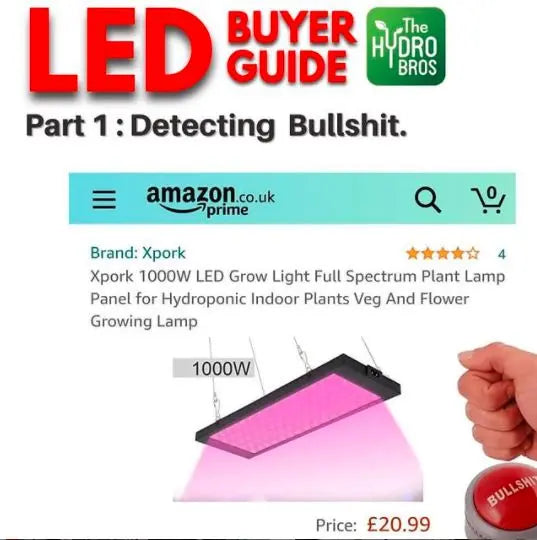
LED Grow Lights vs. Wattage Marketing Hype
HID lights still have their place, but here at The Hydro Bros we’re unapologetically big fans of LEDs. The problem? There’s a lot of noise (and nonsense) around LED wattages. Let’s cut through the 💩.
What Wattage Really Means
The only wattage that matters when comparing grow lights is the actual power draw from the wall. That’s the real-world electricity usage — not a made-up spec pulled from thin air.
Two Common Wattage Scams
-
Quoting the Diode Capacity
Some manufacturers multiply the maximum rating of each diode by the number of diodes. But LEDs are almost never run at full power — if they were, they’d burn hot, lose efficiency, and die fast. That “calculated max” is meaningless. -
“Equivalent To” Wattage
The most abused term in the game. “Equivalent to 1000W HPS” could mean anything. That’s like saying a Ford Fiesta is “equivalent to a Porsche” because they both have four wheels. 🚗💩
Fortunately, most of these jokers lurk on eBay and Amazon targeting easy prey. Still, some sharks do slip into the mainstream, so always check the fine print. 🦈
Wattage vs. Performance
Important note: Higher wattage does not always equal better performance. Efficiency, spectrum, and light distribution matter just as much — if not more. We’ll cover those in Part 2 of this series. 👀
Quick Comparison: Marketing Claims vs. Reality
| Marketing Claim | What It Actually Means | What To Check Instead |
|---|---|---|
| "2000W LED Grow Light" | Usually diode capacity × number of diodes — not real draw | Check actual power draw in watts (e.g. 480W) |
| "Equivalent to 1000W HPS" | Loose comparison, often based on outdated HPS numbers | Look at PPFD (µmol/m²/s) and coverage area instead |
| "High-Power Chips" | Marketing fluff — chips still run at reduced load | See brand (Samsung, Osram) and efficiency (µmol/J) |
How to Spot Legit Grow Light Specs
- Power Draw: Always listed in watts (W) from the wall.
- PPF/PPFD: Actual light output measured in µmol/s.
- Efficiency: µmol/J tells you how much light per watt of power.
- Coverage Area: Reputable brands will show tested canopy maps, not vague claims.
Takeaway
Don’t fall for inflated wattage numbers. Focus on actual power draw, efficiency, and proven light output. Wattage is only part of the story — and we’ll unpack spectrum, PAR maps, and efficiency in our next post.
Got questions? Drop your knowledge bombs in the comments. 💣💬
@TheHydroBros 🇬🇧
Helping you grow 7 days a week! 💪💚🌱


