
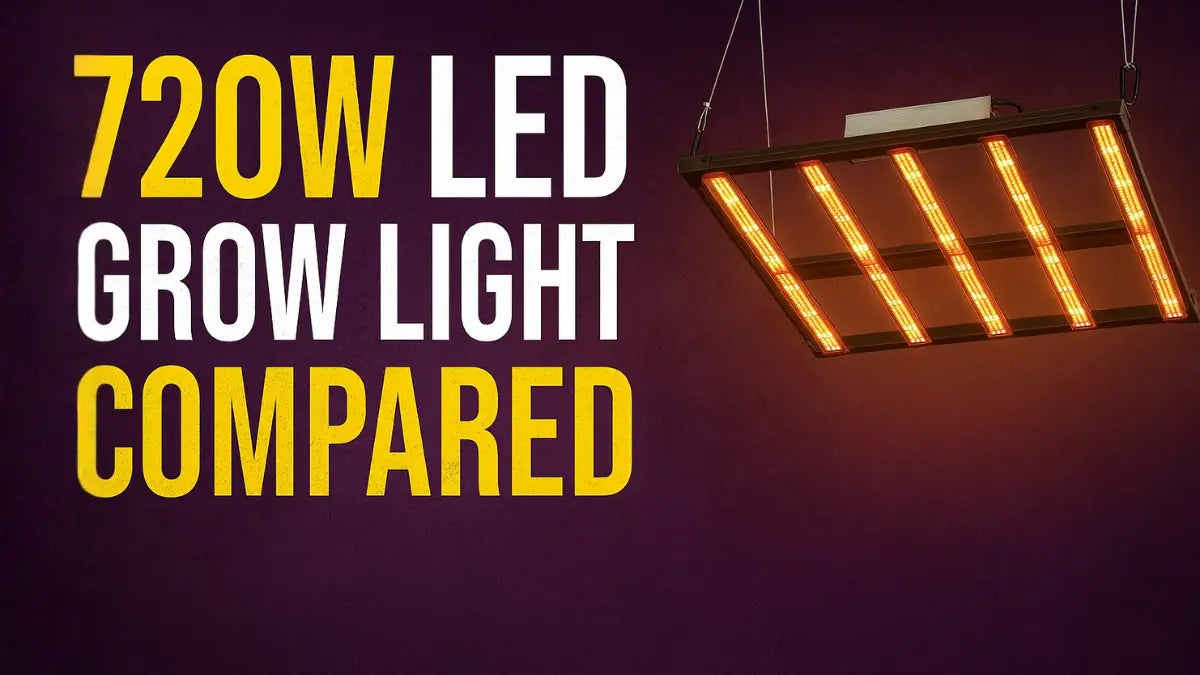
Gorilla vs Omega vs Solar-Tech
Which 720W is Actually Worth It?
Everyone's got a shiny spec sheet and a big claim. We stripped away the marketing and put three of the most talked-about 720W LEDs head-to-head — here's the honest breakdown.
If you're running 720W and you're at the stage where you actually care about efficiency, uniformity and what's really hanging above your canopy — this one's for you. We're not going to pad this out. Here's what we know, what we've seen, and what we'd actually recommend.
The Gorilla GEN-III is what you get when a brand actually understands quality control. 1,944 µmol/s at 2.7 µmol/J, excellent canopy uniformity, and a proper 0–10V dimming system with 25/50/75/100% presets built in.
Here's the bit most people don't know: like a lot of brands, Gorilla's LEDs are white-labelled — but they don't just take whatever comes off the factory line. They batch-test and select their diodes before sign-off, only running the best-performing samples into production. That's not a marketing claim, it's why their failure rate is so low and why their reputation has held up over time.
- Verified, consistent output
- Excellent canopy uniformity
- Proper 0–10V dimming control
- Batch-tested LEDs — rare at this price
- Strong long-term reliability record
- Lower peak PPF than Omega on paper
- Fixed 1.5m × 1.5m footprint
- Less modular than Solar-Tech
On paper, the Omega Black is jaw-dropping. Up to 3.2 µmol/J and ~2,300 µmol/s PPF would put it in the same bracket as premium European fixtures costing triple the price. That's the appeal — and also the reason to pause.
Real-world, independently verified results are harder to come by. There's a story floating around the grow community about a room full of Omegas being pulled down and run over by a tractor after someone put an Apogee meter underneath them. Pub talk or gospel truth, we can't say — but it's the kind of thing that sticks around for a reason.
To be straight with you: the Omega Black does work. It's not a bad unit. But there's a meaningful gap between claimed performance and what growers are measuring in the field — and that matters a lot if you're planning to fill a room.
- Impressive headline numbers
- Works well as a single-light setup
- Lower entry price for the claimed output
- Claimed specs not widely verified
- Real-world PAR can disappoint
- Risky to scale without testing first
- Community confidence is mixed
The Solar-Tech I.D. Split sits in the sweet spot: solid, reliable output at 2.7 µmol/J with a red-boosted spectrum tuned for bloom, running Samsung and Osram diodes. The numbers are real and the real-world performance backs them up.
Where it really pulls ahead is usability. The split hinged frame lets you mount it in tight spaces, angle bars for side lighting, or adapt it to irregular room shapes — genuinely useful if you're not working with a perfect square tent. RJ port connectivity and 0–10V control make it easy to daisy-chain and automate.
Like Gorilla, Solar-Tech work closely with their manufacturing partners and actually test and modify base designs before they go to market. You can feel it in the build — everything feels intentional rather than just rebadged.
- Split frame — genuinely versatile
- Samsung + Osram diodes
- RJ port daisy-chain support
- Bloom-optimised spectrum
- Verified, consistent real-world data
- Slightly lower raw PPF than Omega (claimed)
- More to configure if you want simple plug-and-play
Quick Spec Snapshot
| Model | PPF Output | Efficiency | Coverage | Best For |
|---|---|---|---|---|
| Gorilla GEN-III 720W | 1,944 µmol/s | 2.7 µmol/J | 1.5m × 1.5m | Reliability & peace of mind |
| Omega Black 720W | ~2,300 µmol/s (claimed) | Up to 3.2 µmol/J (unverified) | 1.2m × 1.5m | Single-light curiosity buy |
| Solar-Tech 720W Split | ~1,950 µmol/s | 2.7 µmol/J | Flexible footprint | Flexibility & smart setups |
Always verify with a PAR meter before you scale up
The Omega situation is a good reminder of something that applies to every light, every brand: never fill a room based on a spec sheet alone. A PAR meter takes the guesswork out completely — you'll know exactly what your canopy is receiving, spot dead zones, and dial in your hanging height with confidence. If you're investing in 720W fixtures, a meter pays for itself on the first run.
Shop PAR Meters & Measuring Tools →One more thing worth saying: a light only performs as well as the environment it's in. Dial in your airflow, feeding and canopy spacing before chasing the next decimal in efficiency. The best LED in the world won't save a room with poor VPD or a weak feed strategy.
Shop the full 720W LED range at The Hydro Bros
Fast, discreet UK shipping. Real advice from people who actually grow.
Shop Now →


