
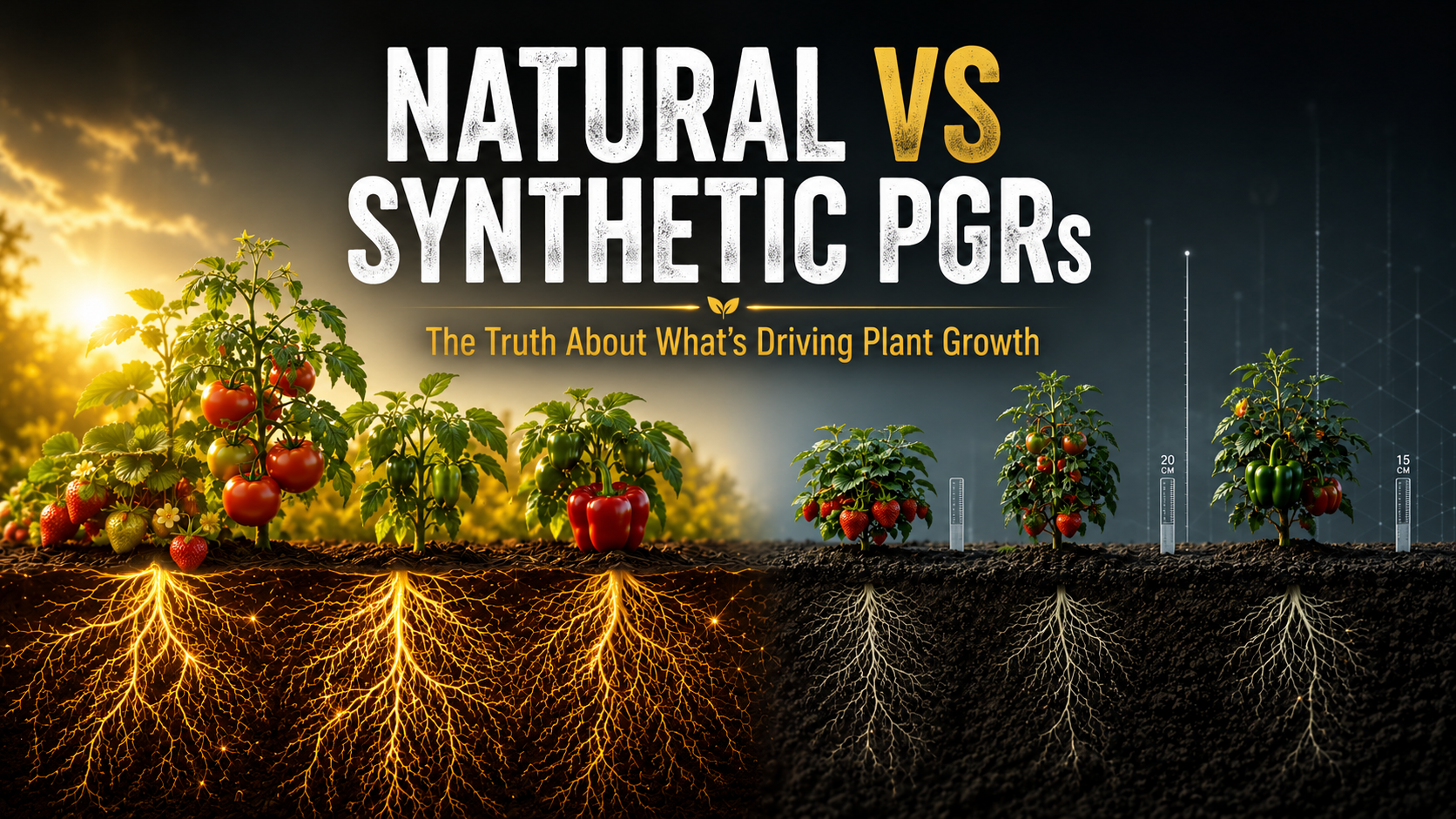
The Good, The Bad & The Ugly
What's Really in Your Nutrient Bottle?
Not all plant growth regulators are the enemy. Some are naturally inside your plants right now. Others are hiding in your PK booster — without mentioning it anywhere on the label.
If you've spent any time in the grow community, you've heard PGR thrown around — usually with fierce loyalty or flat-out disgust. The reality is more nuanced. Not all plant growth regulators are created equal. Some are naturally occurring compounds your plants literally produce themselves. Others are industrial-strength synthetic chemicals originally developed for golf courses and apple orchards — and a surprising number of these are quietly hiding inside bottles that market themselves as "bloom boosters" and "PK enhancers."
Here's the honest breakdown.
These are the PGRs you want in your garden. Most are either naturally occurring plant hormones or derived from organic sources. And here's what cash croppers don't always realise: you can absolutely get heavy, dense, commercial-weight flowers using natural PGR-based products. It just works with your plant instead of forcing it.
Auxins (IAA / IBA) control root development and how the plant directs its growth. IBA is what's in your rooting gel — closely related to what the plant produces naturally, breaks down quickly, and is considered safe. OG Rapid taps into this chemistry to get roots firing fast and plants establishing hard from the jump. More root, more fruit — simple as that.
Cytokinins drive cell division, bud site development, and leaf growth. More bud sites early means more sites to pack weight onto later — heavily present in kelp and seaweed extracts. Monkey Magic leans into natural cytokinin-rich inputs to get plants stacking sites and throwing vigorous growth without any of the synthetic nastiness.
Triacontanol boosts photosynthesis and nutrient uptake (found in plant waxes, especially alfalfa). Chitosan triggers the plant's natural defence system so it spends more energy building flowers and less fighting off disease. Brassinosteroids are natural plant steroid hormones that give your plant backbone during the heavy feeding push of mid-to-late flower.
The bottom line: products like Canna Boost, and Shogun Boost are built squarely around this philosophy — pushing flower swelling and bulk through inputs that work with the plant's own biology. The result is buds that are genuinely heavy and aromatic, with the terpene quality that makes them worth growing. Not the hard, compressed, odourless foam that synthetic shortcuts produce.
- Works with plant biology, not against it
- Safe for consumption — no residue concerns
- Terpene and aroma quality preserved
- Compatible with organic growing
- Heavy, dense flowers without compromise
- No artificial swelling shortcuts
- Rewards good growing — doesn't mask bad growing
- Needs consistent quality inputs to shine
Synthetic PGRs — particularly the triazole class — are designed to force plants into staying short and stacking hard. They work by blocking the hormones that drive stretch. Visually, plants look incredible: short, compact, with dense heavy flowers. But they come with serious baggage that doesn't go away at harvest.
Paclobutrazol (Paclo) is the most well-known and most abused. It stops stretch by shutting down gibberellin production. Buds look stacked and heavy — but terpene production suffers badly. They smell like nothing. The real problem: it persists in plant tissue and in soil for months to years. No established safe residue level for consumable crops. Registered for ornamental use only.
Uniconazole is the same mechanism but 6–10x more potent — sometimes substituted in products to slip past testing panels that only screen for paclobutrazol. Daminozide (Alar) was made infamous when its breakdown product was classified as a probable carcinogen. Chlormequat Chloride has recently been found in a high percentage of human urine samples — likely from contaminated food — with potential reproductive toxicity concerns.
The bottom line? Products such as Diamond Density , Pay Day, OG Rapid, Flower Bomb have become popular because growers often associate them with heavier flowers, tighter internodes and increased density. For anyone chasing maximum weight and bag appeal, it's easy to understand the attraction.
Whether those results come from natural biostimulants, plant-derived growth regulators, synthetic PGRs or a combination of approaches depends entirely on the product formulation. That's why it's important to look beyond the marketing claims and understand exactly what you're feeding your plants.
- Compact internodes — short, tight plants
- Dense, heavy-looking flowers at harvest
- Impressive yield appearance on the bench
- Terpene production gutted — no smell, no flavour
- Persist in tissue and soil for months to years
- No safe residue level for consumable crops
- Ornamental use only — not food grade
- Carcinogenicity and reproductive toxicity links
- Testing is improving — legal exposure is growing
This is the part that should make you angry. A number of PK boosters, bloom stimulators, and late-stage finisher products have been found by independent lab testing to contain paclobutrazol or similar synthetic PGRs — without disclosing it anywhere on the label.
These products hide behind vague descriptions like "proprietary amino acid complex" or list only NPK values while burying the actual active chemistry. The triazole family — paclobutrazol, uniconazole, tebuconazole, propiconazole — all inhibit the same enzyme pathway in plants and in fungi. That dual action is exactly why some manufacturers slip them in without flagging it: they can be framed as "disease management" chemistry while quietly doing PGR work at the same time.
Growers using these products notice the same telltale signs: sudden internode compression, unusually hard and dense-looking flowers, and buds that lack the aroma you'd expect from the genetics. If it looks PGR'd, it probably is.
- Sudden internode compression after application with no environmental change
- Buds that look dense and heavy but smell like very little
- Flowers that feel hard and compressed rather than naturally swollen
- A "finisher" or "ripener" with no disclosed active ingredients
- Any product mentioning "ornamental use only" — even in the fine print
- Results that seem too good to be true with no explanation of why
Paclobutrazol & Its Cousins
All of the following block the same plant hormone pathway. They differ in potency and typical application — but share the same core problems for any consumable crop.
| Compound | Potency vs Paclo | Common Use | Persistence |
|---|---|---|---|
| Paclobutrazol | Baseline | Ornamental horticulture, turf | Very high (months–years) |
| Uniconazole | ≈6–10x stronger | Ornamental floriculture | Very high |
| Tebuconazole | Milder | Agricultural fungicide (incidental PGR effect) | Moderate–high |
| Propiconazole | Milder | Turf and cereal fungicide | Moderate |
| Daminozide | Different class | Ornamental, some post-harvest | Moderate |
| Chlormequat | Different class | Cereal grain production | Moderate |
| Trinexapac-Ethyl | Milder | Golf course turf management | Low–moderate |
| Ancymidol | Similar to Paclo | Greenhouse floriculture | Moderate |
| Flurprimidol | Similar to Paclo | Turf management | Moderate–high |
Grow organic and know every input you use
There's no foolproof way to protect yourself short of two extremes. You're either doing this properly from the ground up — or you're running a mass spec lab. For most growers, the real protection is staying curious, reading labels properly, and being suspicious of any product that delivers results that seem too good to be true without a clear explanation of why.
One more thing worth saying: dense flowers and aromatic flowers are not mutually exclusive. The right inputs, dialled in properly, deliver both. Don't accept the trade-off that synthetic shortcuts tell you is inevitable.
Grow heavy. Grow clean. Shop The Hydro Bros.
Fast UK shipping. Real advice from people who actually grow.
Shop Bloom Boosters →


