
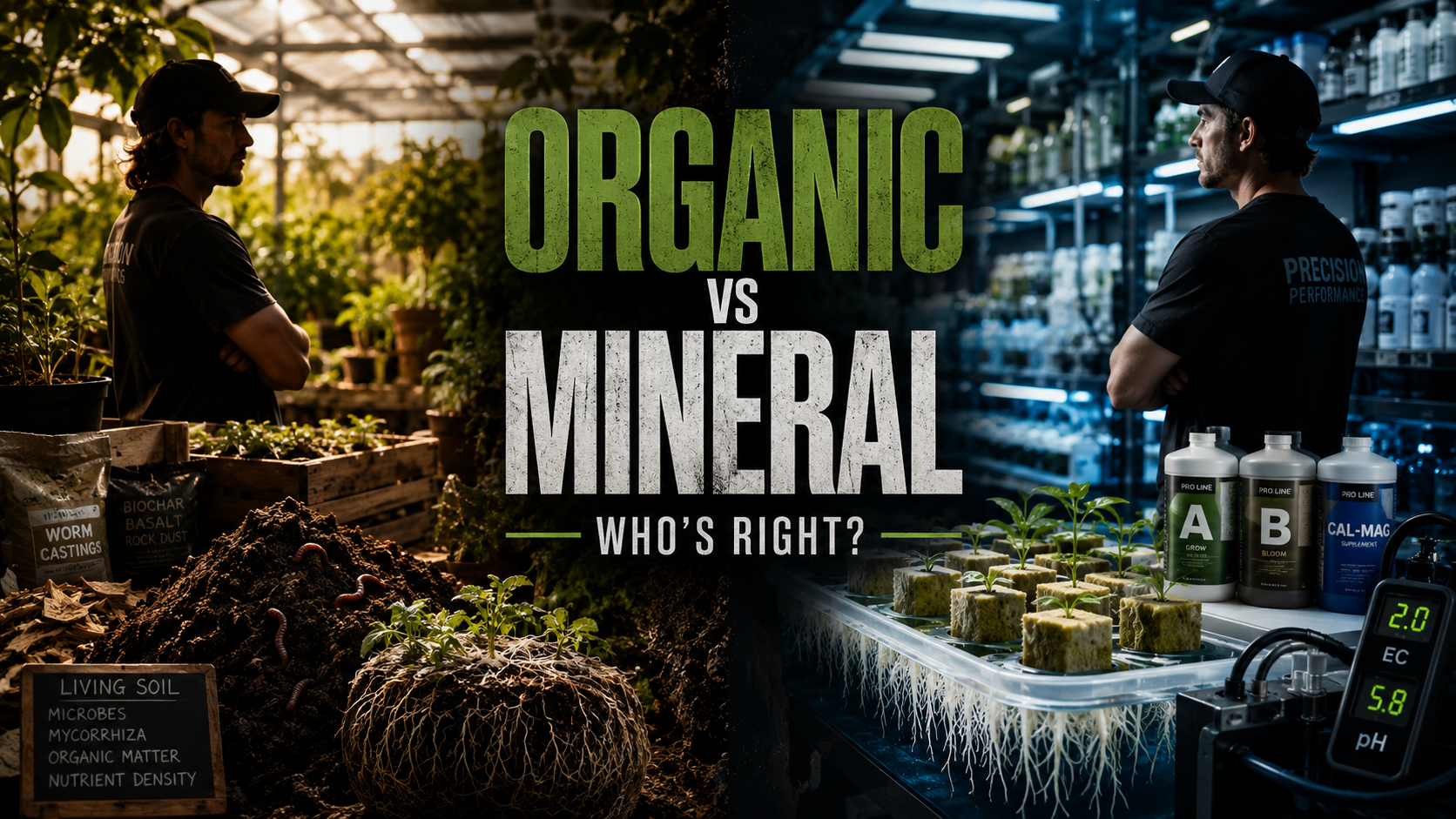
Organic vs Mineral Nutrients:
What Actually Matters
for Your Grow
Spend five minutes in any growing forum and you'll find the same argument playing out in real time. Organic growers versus mineral growers. Living soil versus bottled nutrients. Biodynamic philosophy versus EC charts and feed schedules.
Online, it can feel like organics are taking over. Walk into most UK hydro stores, and you'll find a very different picture.
The Honest Numbers
That's not a scientific study — it's what actually leaves the shelves. Brands like CANNA, Athena, Shogun and Terra Aquatica dominate for a reason: they're reliable, consistent, and they work.
Organics are absolutely growing in popularity. But they're still a small slice of the market, despite how loud the online conversation can get.
Two Kinds of Organic Grower
Not all organic growers are the same. In our experience, they tend to fall into one of two camps:
The Convenience Grower
They want a more natural approach — but they also want to pick up a bottle, follow a schedule, and get on with it. Brands like BioBizz, BioTabs and Crazy Hills serve this grower perfectly. Organic growing doesn't have to mean becoming a soil scientist.
The Living Soil Enthusiast
These growers are deep into microbial ecosystems, worm castings, compost teas, ferments, rock dusts and custom soil blends. For them, building the soil is the hobby. It's a genuinely fascinating rabbit hole — and once you're in, it's hard to leave.
YouTube Changed Everything
Ten years ago, most growers followed whatever their local hydro store recommended. Today, a grower can spend a weekend watching content and come in Monday morning asking specifically for Gaia Green.
There's a good chance they've been watching Mr Canucks Grow.
Social media has accelerated the spread of organic techniques faster than anything else. That's not a bad thing — it means more growers exploring new methods, more experimentation, more knowledge sharing. But it has created a loud online conversation that doesn't always reflect what's actually happening on the ground.
What Actually Determines Quality?
Here's where a lot of growing discussions fall apart. People want a clean answer — organic = better, mineral = worse, or vice versa. But growing doesn't work like that.
Final quality is shaped by dozens of factors: genetics, environmental control, root zone health, irrigation strategy, harvest timing, drying, curing, and overall grower skill.
A badly grown organic crop will still produce a disappointing result. A perfectly grown mineral-fed crop can produce something exceptional.
A mediocre grow dried perfectly will often beat an amazing grow that was dried badly.
Drying and curing have an enormous impact on quality — arguably more than what's in the feed bottle. Yet growers spend hundreds of hours debating nutrient brands and relatively little time dialling in their drying room.
Mineral vs Organic: The Real Trade-offs
Both approaches work. Both have genuine strengths and genuine limitations. Here's how they actually compare:
That last point surprises a lot of people. Premium composts, worm castings, microbial inoculants, dry amendments and specialist inputs — it adds up fast. Organic growing is not always the low-cost approach many assume it to be.
The Conclusion Most Experienced Growers Reach
After enough time growing, most people arrive at the same place.
You can produce incredible results with organics. You can produce incredible results with mineral nutrients. You can produce disappointing results with either — if you neglect your environment, your irrigation, your genetics, or your post-harvest process.
The nutrient bottle alone rarely makes or breaks a grow.
Plants don't care about ideology. They care about stability, consistency and care. Whether you find that in a living soil ecosystem, a bottle of two-part mineral base, coco, Rockwool or DWC — the fundamentals don't change. Master those, and the nutrient debate becomes a lot less important.
Plants don't care what logo is on the bottle.
They respond to consistency.


